
Why Most Shopify Stores Treat Returning Visitors Like Strangers
And what mid-market merchants can do about it, without enterprise software or a six-month integration.
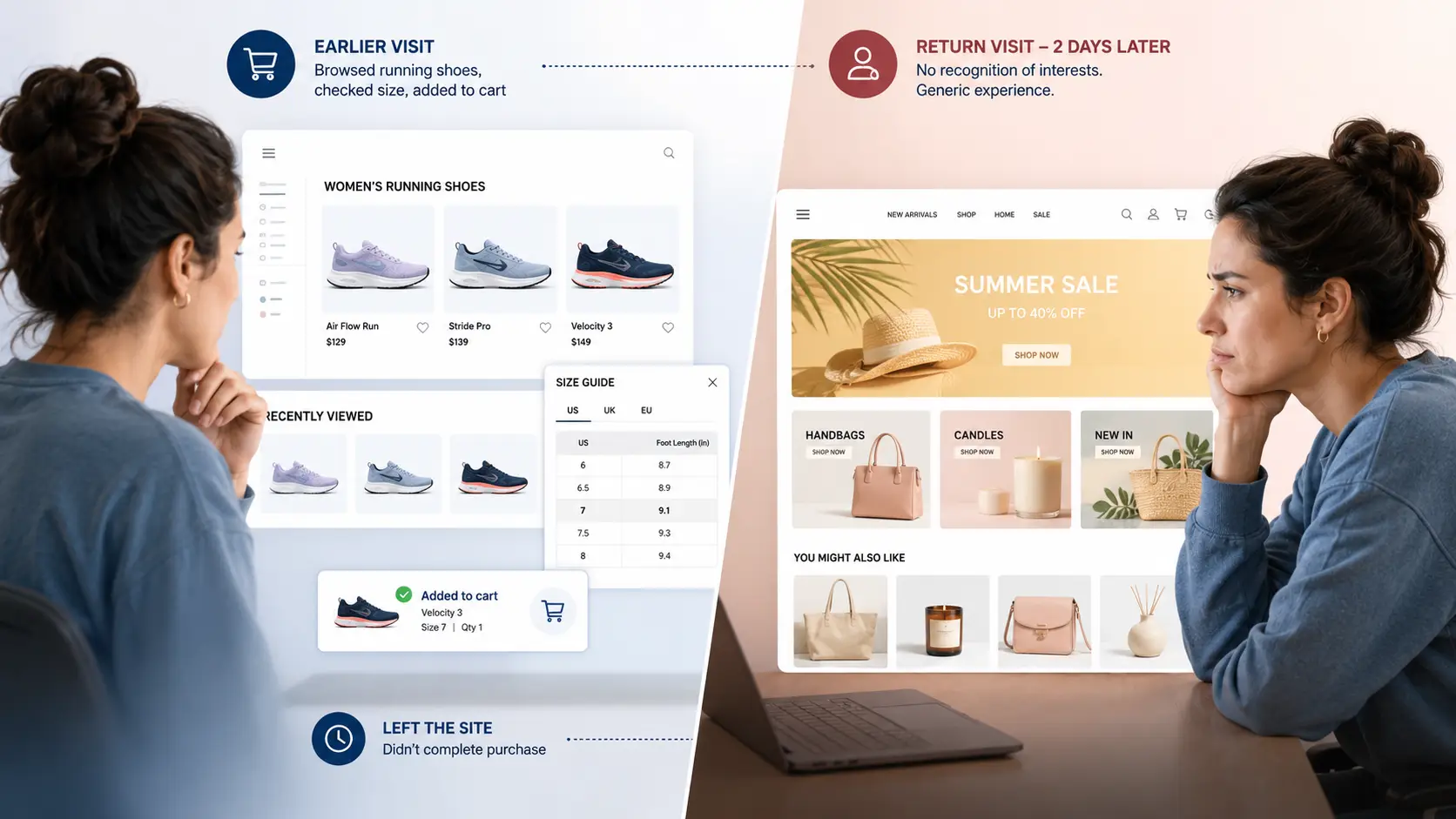
A shopper visits your store. She browses three pairs of running shoes, checks the sizing guide, adds one to cart, then leaves. Two days later she comes back, same browser, same device, clearly still interested and lands on a homepage full of handbags, candles and a hero banner promoting a summer sale she’s already seen.
Nothing about her return visit feels like a return visit.
We’ve spent the last two years at Pinpointed building AI tools that help retailers turn browsers into buyers. Our AI Sommelier does this for wine and spirits stores, answering customer questions, recommending from live inventory, and helping shoppers choose with confidence.
But as we talked to more Shopify merchants outside of drinks in apparel, beauty, homeware, electronics, gifting, we kept hearing the same frustration: “We know our returning visitors are interested. We just can’t show them anything different.”
That’s the problem we built Pinpointed Concierge to solve.
The personalisation gap is real and surprisingly wide
A 2026 study by StoreInspect scanned over 232,000 Shopify stores and found that only around 2.5% use any form of storefront personalisation. Not 2.5% doing it badly, 2.5% doing it at all.
Among Shopify Plus stores the number climbs to roughly 65%, which makes sense. Plus merchants tend to have bigger teams, bigger budgets, and access to enterprise platforms like Nosto and Dynamic Yield that start at several hundred dollars a month and require serious implementation effort.
But the mid-market stores doing $500K to $10M in annual revenue, is mostly unserved. These merchants have enough traffic and product depth for personalisation to matter, but not enough budget or engineering resource for enterprise tools.
We saw the same pattern in drinks retail before we built the Sommelier. Big retailers had recommendation technology. Independent merchants had nothing. The gap was the opportunity.
Why the gap exists
It’s not that merchants haven’t heard of personalisation. Ask any Shopify store owner whether they’d like to show returning visitors a different homepage and the answer is obviously yes. The blockers are practical.
The enterprise tools are too expensive. Nosto, Dynamic Yield and Algonomy are powerful platforms built for large teams with dedicated e-commerce engineers. Pricing starts in the hundreds per month and scales with traffic, exactly the cost model that mid-market stores can’t justify before they’ve seen results.
The budget tools are too narrow. Apps like Wiser and LimeSpot are affordable and work well for what they do product recommendation widgets on product pages and in the cart. But they don’t change the homepage. They don’t adapt hero banners. They don’t build visitor profiles from anonymous browsing behaviour. The storefront stays static; only the recommendation blocks change.
Shopify’s built-in tools cover the basics. Search & Discovery handles related products and basic search filtering. It’s free, it’s native, and for many stores it’s good enough to delay the conversation about third-party personalisation. But “related products” on a product page is a long way from “this homepage is different because we know you’re interested in running shoes.”
The technical lift is underestimated. True storefront personalisation requires multiple layers working together: visitor identification, event collection, profile building, segment evaluation, content matching, and rendering all without slowing down page load. Each layer is individually straightforward, but stitching them together across Shopify’s architecture takes real engineering.
What “personalisation” actually means for a Shopify store
The word gets thrown around loosely, so it’s worth being specific. In the context of a Shopify storefront, personalisation can mean several things and they’re not all equal.
Product recommendations are the most common form. “You may also like” and “Frequently bought together” widgets appear on product pages and in the cart. Useful they expose products the shopper might not find on their own, but they’re reactive. The shopper has to reach a product page before the recommendations appear.
Homepage personalisation is less common but arguably more impactful. Changing the hero banner, the featured collection, and the calls to action based on who the visitor is means the very first thing they see is relevant. A returning shopper with clear category interest sees products in that category. A VIP sees a loyalty message. A high-intent visitor who abandoned cart yesterday sees a nudge. The homepage becomes a different page for different people.
Behavioural messaging covers triggered banners, return-visit prompts and intent-based offers that use the shopper’s actual behaviour as context. “Still thinking about those running shoes?” is a fundamentally different message from “Check out our summer sale” and the difference in click-through reflects that.
Segment-based targeting ties all of the above together. Instead of one-size-fits-all content, merchants define visitor groups, new visitors, returning browsers, VIP customers, high-intent shoppers, category enthusiasts and assign different storefront experiences to each.
The point is that personalisation isn’t just a recommendation widget. It’s the storefront adapting across the homepage, product pages, cart and post-purchase based on what each visitor has actually done.
The anonymous visitor problem
Here’s the part that most tools handle poorly. The vast majority of Shopify traffic is anonymous. Visitors browse without logging in, and many never create an account at all. If personalisation only activates after login, it covers a fraction of your traffic.
First-party cookie-based identification changes this. When a visitor arrives, a lightweight identifier is set. On subsequent visits, even without login, the store recognises the browser and retrieves a browsing profile built from previous sessions. Products viewed, categories browsed, price ranges explored, cart behaviour, return frequency, all of this builds over time, attached to an anonymous profile.
When that visitor does eventually log in or make a purchase, the anonymous profile merges with their customer record. But the personalisation doesn’t wait for that moment. It works from the second visit onward.
This is the approach that Shopify’s own Customer Privacy API supports. Events are consent-aware, the data is first-party, and there’s no dependency on third-party cookies. Privacy-respecting by design, not by compromise.
What we built: Pinpointed Concierge
We took what we learned building the AI Sommelier, working with real inventory data, understanding shopper intent, proving ROI to independent retailers, and applied it to the broader storefront personalisation problem.
Pinpointed Concierge is a Shopify app that adapts the storefront for returning visitors. It covers three layers that work together:
Anonymous visitor profiling. A Shopify web pixel tracks browsing events (page views, product views, cart actions, searches) and builds first-party visitor profiles. Category affinities, price range interest, brand preferences and visit patterns all accumulate over time, without requiring login.
Dynamic homepage content. Hero banners, featured collections and CTAs change based on the visitor’s segment. A new visitor sees smart defaults. A returning browser sees content shaped by their interests. A high-intent visitor sees a different message entirely. Merchants control this through Shopify’s theme editor using app blocks, no code editing required.
Smart product recommendations across the funnel. “Picked for you” on the homepage, “You may also like” on product pages, cart cross-sells, personalised search results, and post-purchase recommendations. The engine blends collaborative filtering (what similar buyers purchased) with content-based similarity (what matches this visitor’s profile), and falls back to bestsellers and trending products for cold-start scenarios.
Everything renders through Shopify theme app extension blocks, so merchants add and position placements through the theme editor. Revenue attribution tracking shows which recommendations led to clicks, add-to-carts and purchases.
What mid-market merchants should look for
Whether you’re evaluating Concierge or any other personalisation tool, here’s what matters for stores in the $500K–$10M range:
Works from day one. The app should show value immediately, trending products, bestsellers, smart defaults and improve as data accumulates. If it requires weeks of configuration before anything changes on the storefront, most merchants will abandon it.
Covers more than product pages. Recommendation widgets are a good start, but the homepage is where the biggest opportunity sits. Look for tools that can change hero content, featured collections and CTAs, not just “you may also like” blocks.
Handles anonymous visitors. If the tool only personalises for logged-in customers, it’s ignoring the majority of your traffic.
Proves its own value. Revenue attribution, tracking which recommendations led to purchases is essential. Without it, you’re paying for a tool you can’t evaluate.
Doesn’t require a developer. Shopify’s theme app extension system means merchants should be able to add personalisation blocks through the theme editor without touching Liquid code.
Predictable pricing. Session-based pricing with clear tiers is more manageable than percentage-of-revenue models.
The opportunity is in the gap
That 2.5% adoption figure is a market timing signal. Consumer expectations around personalised shopping have been shaped by Amazon, Netflix and Spotify but the tools available to independent Shopify merchants haven’t kept pace.
The enterprise platforms serve the top end. The free built-in tools serve the bottom. The middle has been underserved and that’s where the most Shopify stores actually sit.
The stores that adopt storefront personalisation now, while 97% of Shopify stores haven’t, will have a compound advantage. Visitor profiles build over time. Segments sharpen with data. The longer you run personalisation, the better it performs, which means the cost of waiting isn’t just missed revenue today, it’s a thinner data foundation tomorrow.
Pinpointed Concierge is now available for Shopify merchants. It adapts your homepage, product recommendations, banners and CTAs for returning visitors using first-party behaviour data.
→ Learn more about Pinpointed Concierge
→ Book a call to discuss your store
This is the first in a series of articles about Shopify storefront personalisation. Coming next: a practical comparison of the leading personalisation apps for mid-market Shopify stores.