
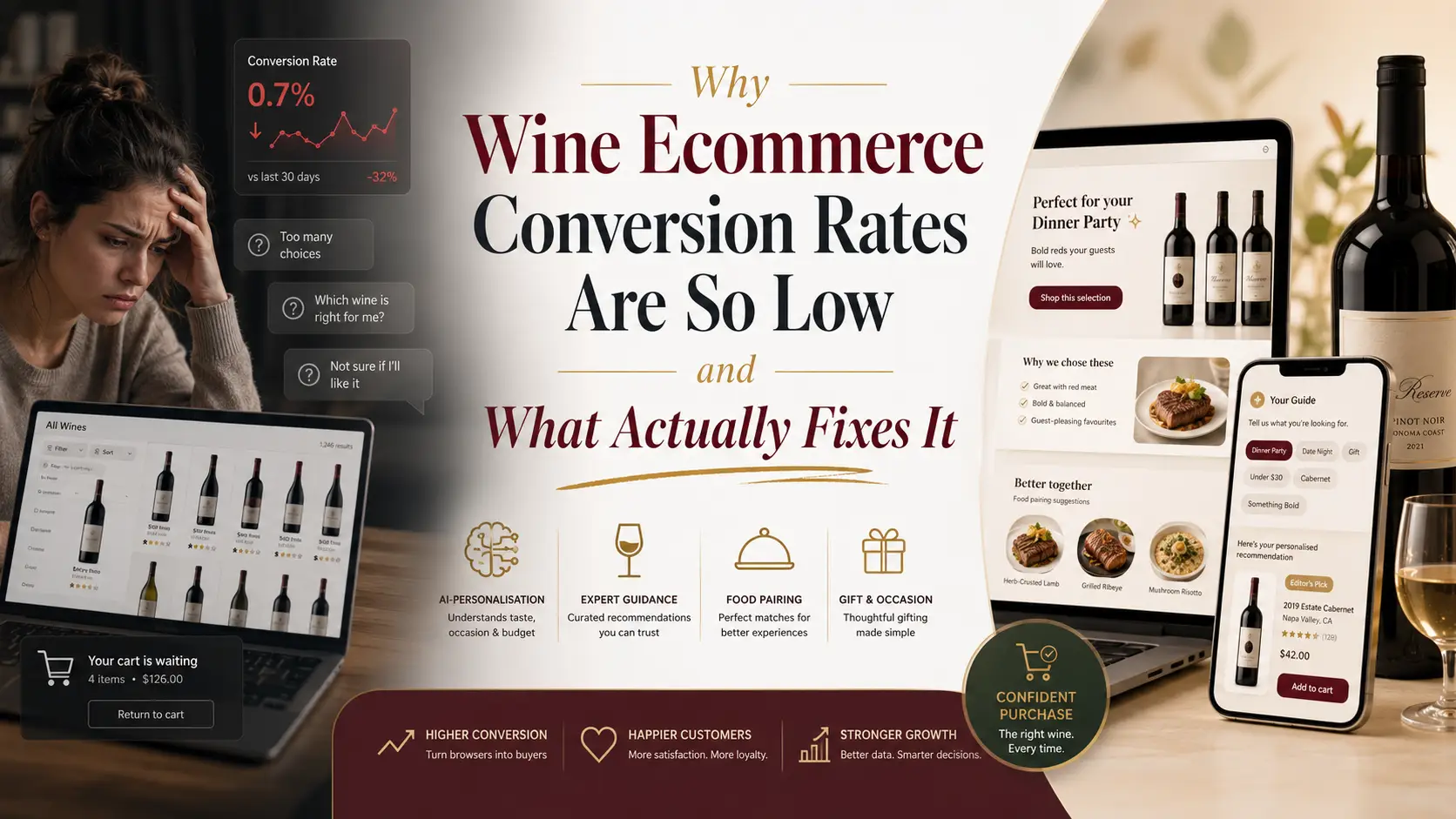
Why Wine Ecommerce Conversion Rates Are So Low and What Actually Fixes It
A customer comes into the shop on a Friday evening, they’re cooking lamb and they’ve got about thirty euros to spend. They don’t really know what they want and this is the part that matters, they don’t want to look like they don’t know.
Twenty years on a shop floor teaches you that the sale is almost never about the wine. It’s about the thirty seconds before the wine. The moment where someone needs to choose. Online, that moment is exactly where you lose them.
Traffic is not your problem
Most specialist retailers I speak to are trying to fix conversion by pouring more people into the top of the funnel. More ads, more SEO and more retargeting. The logic is that if conversion is 1%, you need ten times the traffic. But a low conversion rate on a wine or spirits site is rarely a traffic quality problem. Your visitors want wine, they came to a wine shop, they arrived with intent and they left because they couldn’t decide.
The catalogue trap
Here’s what happens when that Friday evening customer lands on your site instead of walking through your door. They see two thousand bottles. They see filters, regions, grapes, vintages, prices, style and maybe closure. Every one of those filters is a question that only makes sense if you already know the answer. Region? they don’t know. Grape? they don’t know. Style? “elegant,” “structured,” “mineral”? That’s not a filter, that’s like an exam.
The search box has the same flaw, it assumes the customer can name what they need, but nobody types “Côtes du Rhône Villages 2021.” They think “something that goes with lamb, not too expensive, not embarrassing to bring to my in-laws.” Your filters cannot answer that. Your best member of staff answers it in seconds.
More choice makes this worse, not better
This is the uncomfortable part for specialist retailers, because range is usually the thing you’re proudest of. But a deep catalogue is only an advantage when it comes with guidance. Without it, every additional bottle is one more reason to hesitate. The customer who would have bought one of five bottles walks away from two thousand. That’s not a failure of your buying, it’s a failure of the interface between your expertise and your customer.
What the data says
Consumers have already told the industry what they want here. The Capgemini Research Institute’s 2025 consumer trends report found that 71% of consumers want generative AI built into their purchasing experience. They’re not resisting the technology, they’re waiting for it to be useful. The 2026 edition, published in January and based on 12,000 consumers across 12 countries, sharpens the point considerably. Consumers are embracing AI to help them navigate the market, but they favour brands that combine digital convenience with in-person assistance. That’s the whole argument in one line, from a source with no product to sell you.
There’s a third finding worth noting. A Kinsta survey of 1,011 US consumers found that 93% would rather deal with a human than an AI agent, 84% think humans are more accurate and 81% believe AI is deployed to cut costs rather than to improve service. That study looked at customer support rather than shopping, but the sentiment travels.
Read all three together and the conclusion is clear. Customers don’t object to AI,they object to AI that replaces the person who used to help them, that distinction is the whole game.
Guidance, not more search
The fix isn’t a better filter system. It isn’t a bigger search box or a smarter autocomplete. It’s asking the customer a question before recommending anything. On the shop floor, nobody hands you a bottle in the first sentence. They ask what you’re cooking, roughly how much you want to spend and maybe if it’s a gift. Then they put one bottle in your hand and tell you why.
That sequence, ask, understand, recommend one thing, explain the reason, is what converts. It converts in store and it converts online. Most wine e-commerce sites skip straight to the recommendation or skip the recommendation entirely and hand over a grid.
What guided commerce does is put that conversation back on the website:
- The customer asks in their own words: “something for lamb, around thirty euros”
- The site asks one or two clarifying questions, how it’s being cooked, whether it’s a gift
- It recommends a small number of bottles, from live inventory, with a plain-English reason for each
- Every recommendation links straight to the product page
No jargon, no exam and one click from checkout.
What we see in real conversations
Across 19 specialist wine and spirits retailers, 8.6% of guided conversations ended with the customer clicking through to a bottle we recommended 19 sessions out of 221. I’m publishing the denominator deliberately, because almost nobody in this category does. A click-through rate is meaningless unless you know what it’s a percentage of. Ours is sessions, a customer opened the conversation, answered the questions and clicked a bottle they were shown. That’s not impressions or page views. It’s early data from a small base and it will move as more stores come online. But it’s measured from real customers on live stores, not modelled and not rounded up.
Here’s the part I find more interesting. When we look at which recommendation gets clicked, the first one takes roughly half of all clicks on its own. Everything below it competes for the rest. Twenty years on the floor would have told you that. You hand someone one bottle and explain why, you don’t fan out five and let them choose.
The question worth asking
Before you spend anything more on traffic, ask a simpler question about the traffic you already have, When a customer arrives on your site not knowing what they want, what happens next? If the answer is “they use the filters,” you already know how that ends. People shouldn’t need to be experts to buy expertly. That’s true on the shop floor, and there’s no good reason it stops being true online.
See what your customers are actually asking. Pinpointed turns your inventory and your expertise into guided online shopping. Book a 30-minute call and I’ll walk you through what it looks like on a store like yours.